Langflow 1.8 is released! This version focuses on three areas: centralized provider configuration, more predictable workflow APIs, and faster debugging and iteration in the UI.
Core improvements
-
Global model provider setup
-
API Redesign (Phase 1): V2 API + standardized workflow endpoints (beta)
-
Faster debugging and iteration: Traces + Inspection Panel + Playground updates
Also included:
- Knowledge bases
- Mustache templating support for the Prompt Template component
- New Agentics, Guardrails, and LiteLLM components
- Modular dependency installation with
langflow-base - …and more
Let's dig into some of these features to see how they reduce configuration overhead, simplify integrations, and speed up your build-and-debug loop.
Global model providers
Language model providers can now be configured centrally, and with settings that apply across your entire Langflow instance.
Instead of managing provider credentials and settings inside individual LLM components, you can set them once in the Models pane and reuse them across flows and components. This reduces credential sprawl and configuration drift and makes rotating keys or switching providers a single update, rather than a canvas-wide manual edit.
API redesign with v2/workflow endpoints (beta)
Langflow 1.8 introduces a new Developer API with dedicated v2/workflow endpoints.
The main improvements are a much simpler response, and support for asynchronous background jobs.
Here's an example POST request to the v2/workflow endpoint:
import requests

url = f"{LANGFLOW_SERVER_URL}/api/v2/workflows"
headers = {
    "Content-Type": "application/json",
    "x-api-key": LANGFLOW_API_KEY
}

payload = {
    "flow_id": "flow_67ccd2be17f0819081ff3bb2cf6508e60bb6a6b452d3795b",
    "background": False,
    "inputs": {
        "ChatInput-abc.input_type": "chat",
        "ChatInput-abc.input_value": "what is 2+2",
        "ChatInput-abc.session_id": "session-123"
    }
}

response = requests.post(url, json=payload, headers=headers)
print(response.json())
Responses are cleaner and flatter, so they're easy to work with in your application.
{
  "flow_id": "flow_67ccd2be17f0819081ff3bb2cf6508e60bb6a6b452d3795b",
  "job_id": "job_id_1234567890",
  "object": "response",
  "created_at": 1741476542,
  "status": "completed",
  "errors": [],
  "inputs": {
    "ChatInput-abc.input_type": "chat",
    "ChatInput-abc.input_value": "what is 2+2",
    "ChatInput-abc.session_id": "session-123"
  },
  "outputs": {
    "ChatOutput-xyz": {
      "type": "message",
      "component_id": "ChatOutput-xyz",
      "status": "completed",
      "content": "2 + 2 equals 4."
    }
  },
  "metadata": {}
}
For asynchronous or long-running jobs, set background: True in the request payload.
The endpoint returns a job_id, which you can poll for status and results.
For more information, see the Workflow API documentation.
This feature is in beta, and we welcome your feedback as we improve the API.
Faster debugging and a more responsive Playground
Langflow 1.8 includes UI improvements designed to make iteration faster and troubleshooting less of a black box.
Langflow traces (flow and component traces)
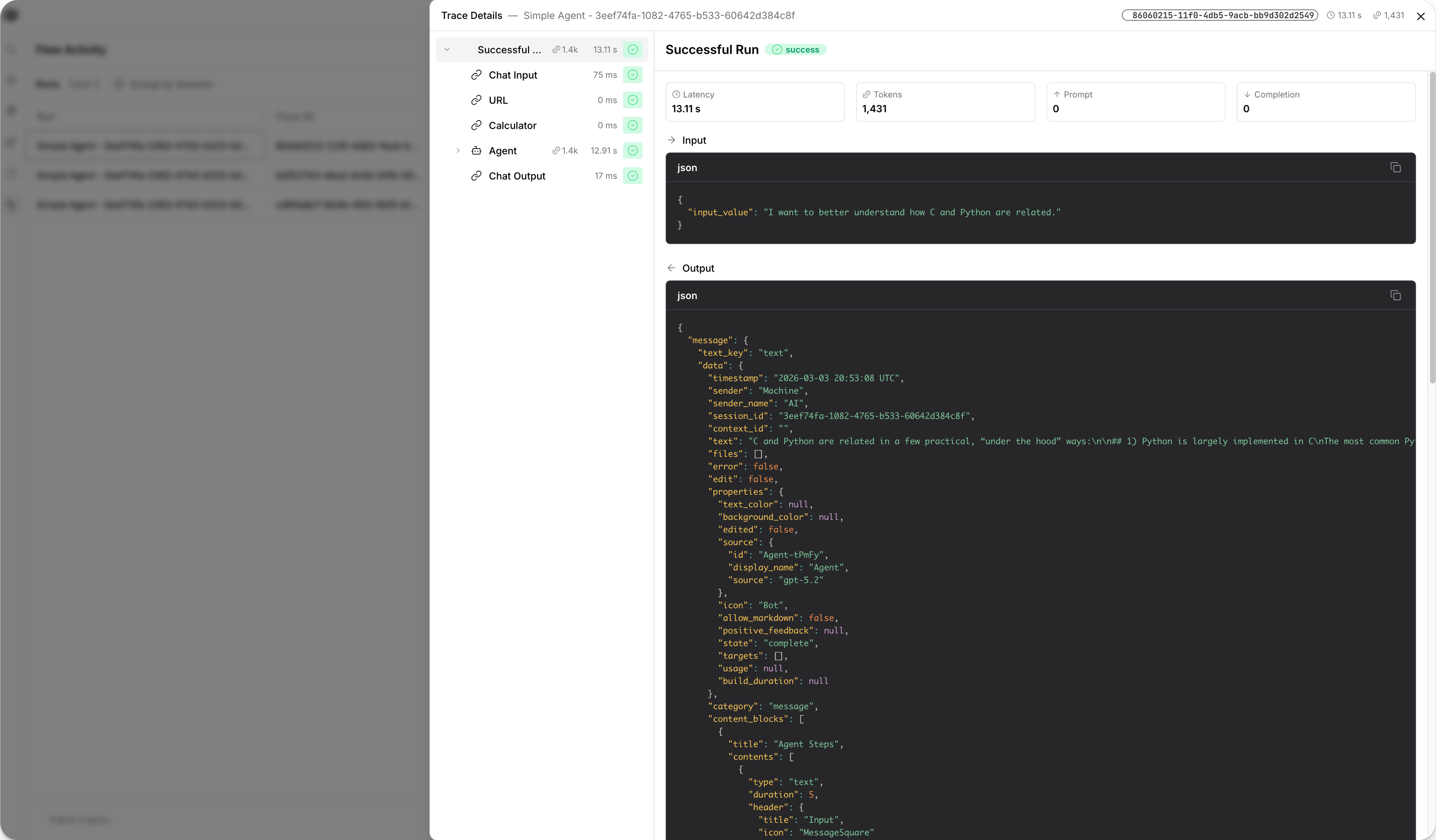
Langflow’s traces feature records detailed traces and spans for your flows and components, helping you debug issues, measure latency, and track token usage within your flows. This makes it easy to understand how your flows actually run, so you can quickly spot issues and get back to building.
For more information, see Traces.
Inspection panel (real-time component inspection)
Langflow 1.8 adds a dedicated inspection experience that lets you inspect a component's internal state, inputs, and outputs during or after execution. This reduces reliance on external logs or print statements to verify data flow between specific nodes.
This inspection view surfaces execution details like inputs/outputs, logs, tokens, and component state in the workspace UI, so you can troubleshoot issues and tune components more quickly.
Playground updates (optimized messaging architecture)
The messaging architecture has been overhauled to handle complex data types and large message histories with lower latency. You’ll experience a more responsive chat interface during long streaming sessions, with faster rendering and reduced browser memory overhead.
Knowledge bases (local vector databases)
A knowledge base is a local vector database stored in Langflow, so your data doesn’t need to be fetched and re-ingested from a remote service on every run. Knowledge bases makes it easy to work with vector data directly inside your flows. For more information, see Knowledge bases.
Mustache templating for Prompt Template
The Prompt Template component now supports Mustache templating, making variable injection and dynamic prompting easier.
For more information, see Prompt template.
Modular dependency installation
Langflow 1.8 introduces the langflow-base package. When you install langflow-base you don't automatically install all of Langflow's dependencies. Instead, you only need to install the modules that you require to run your application, as well as any custom dependencies.
This reduces the overall installation size, making your Langflow setup leaner and more focused, while also making it easier to customize your Langflow environment.
For more information, see Install custom dependencies.
New components
Langflow 1.8 includes three new components:
- The Agentics bundle uses LLMs to fill, collapse, or generate tabular data.
- The Guardrails component validates flows by issuing prompts to an LLM.
- The LiteLLM bundle connects to multiple LLMs through a proxy.
There's more to come
For more on all the changes that have been released in Langflow 1.8 you can check out the release notes or the full release on GitHub.
We're committed to continuously improving Langflow, and your input is crucial to this process. If you want to get more involved you can:
- Join our Discord community to network with other developers
- Explore our GitHub repository to contribute to the project or 🌟 the project
- Subscribe to our YouTube channel for step-by-step guides on using Langflow
- Stay updated on the latest AI trends and insights by subscribing to the AI++ newsletter
We're excited to see the projects you'll create with the Langflow 1.8 open-source package. Check out the 1.8.0 release on GitHub and get building!
To download Langflow Desktop 1.8, see Download Langflow Desktop.