Getting started with AI agent builders
How AI agent builders can help even the most complex AI projects move seamlessly from prototype to production.
Get started with LangflowCreate your first flow
Join thousands of developers accelerating their AI workflows with Langflow.
Get Started for FreeAI agents promise to bring a new level of autonomy and intelligence to generative AI (GenAI) apps.
The problem is getting them out the door.
A study from MIT’s Project NANDA asserted that 95% of companies’ GenAI projects fail before reaching production. The primary culprit: the learning gap, both for tools and organizational composition.
Intuitive tools can help close the skills gap by shortening the onboarding window for GenAI technology. In particular, AI agent builders can play a critical role throughout the entire AI agent development lifecycle, providing a path to rapidly prototype, develop, productize, and deploy new agent-based solutions.
How do you select the right AI agent builder to suit your company’s workflows? In this article, we’ll run down what AI agent builders are, why and when to use them, and how to get started.
What are AI agents?
AI agents are AI-driven systems that autonomously perform tasks. They leverage the linguistic and generative capabilities of Large Language Models (LLMs) to solve complex problems across the enterprise.
LLMs, machine learning models, and other AI solutions are reactive - i.e., they respond to user requests. By contrast, AI agents are proactive. They are constantly perceiving their defined environment and looking for opportunities to take action based on incoming data. They then employ planning and reasoning techniques to take action independent of human input.
An AI agent typically consists of a few key components:
- An LLM, which provides basic natural language processing capabilities as well as generation of text, images, audio, and video
- Tools that LLMs can call - external APIs, data stores, memory, etc. - to supplement their core knowledge
- Workflow orchestration to coordinate performing tasks in a defined sequence
What are AI agent builders?
AI agent builders are tools that enable rapidly prototyping, developing, and deploying new agents from scratch. These tools may also be called workflow tools or workflow builders.
AI agent builders will typically supply:
- Tools integrations with the most popular LLMs, data storage systems, and data sources
- Components that simplify common tasks such as building simple agents, multi-agent workflows, storing and accessing message history, and connecting to third-party systems via protocols such as Model-Context Protocol (MCP)
- A visual workflow builder for rapid prototyping and development of new applications using a low-code or no-code approach
- Support for multi-agent workflows for building complex, intelligent workflows composed of dedicated agents that specialize in specific tasks
- A rapid prototype-to-deployment pipeline that supports moving quickly from visual builder to a scalable production deployment
Key benefits of an AI agent builder
Rapid prototyping. AI agent builders support testing out ideas quickly, so that developers can hand them to stakeholders and get feedback on their utility. Once everyone agrees on the agent’s capabilities, the prototype can be developed further into a production-ready, scalable GenAI solutions.
Out-of-the-box GenAI capabilities. Many of the common tasks involved in building agents are “undifferentiated heavy lifting.” They’re capabilities - e.g., a retrieval-augmented generation (RAG) pipeline - required by all agents that would be wasteful to build over and over again for every new project. An AI agent builder provides these features as pre-built, reusable, and reliable components to reduce development time.
Easier onboarding. As the Project NANDA study shows, ramping up on GenAI technology is a key reason why so many projects fail. Because it encapsulates some key concepts using pre-built components, an AI agent builder can get developers building applications faster than if they had to start from scratch.
Low-code and code switching. A low-code/no-code builder makes easy tasks easy. Hard tasks, however, are still hard and generally require dropping down to code. A good AI agent builder supports switching between both modes as needed.
AI agent builders on the market today
There are a number of dedicated AI agent builders on the market today. A few factors that distinguish the different offerings include:
- Self-hosted vs. cloud-based capabilities (self-hosted capabilities are critical for supporting agentic solutions in highly secure and regulated environments, such as healthcare and government)
- External integrations, particularly the number and type of supported LLMs
- Scalable infrastructure to handle large data and request volumes
A few of the more popular offerings include:
-
Langflow, our our AI agent builder designed to be easy-to-use and enterprise-ready. With Langflow, you can translate complex ideas into visual workflows that are easy to understand. Langflow supports iterative swapping between the visual builder and Python code, enabling you to tackle projects of any complexity.
Langflow is available as a self-hosted Docker container or as part of the DataStax AI Platform, which pairs Langflow with AstraDB, our low latency vector and NoSQL AI database, and Astra Streaming, a real-time data pipeline platform for GenAI apps.
-
Dify, an open-source data, AI-centric agentic workflow builder that supports collaborative nested workflows.
-
n8n, a general workflow automation platform used by both technical and non-technical users. While not initially developed as an AI-centric solution, it supports building agentic workflows.
-
Flowise, another open-source system that supports quick creation of chatbots, multi-agent workflows, and human in the loop scenarios for greater accuracy and control.
How to use an AI agent builder
By definition, it should be easy to get started with an AI agent builder. The best AI agent builders will combine a short ramp-up and develop/test cycle time with the ability to deploy a scalable solution that can handle millions of requests and petabytes of data.
Langflow also includes a number of starter templates encapsulating common agent patterns. Using these, you can build and deploy a simple agent in hosted Langflow in less than 5 minutes with the following steps:
Create a free account
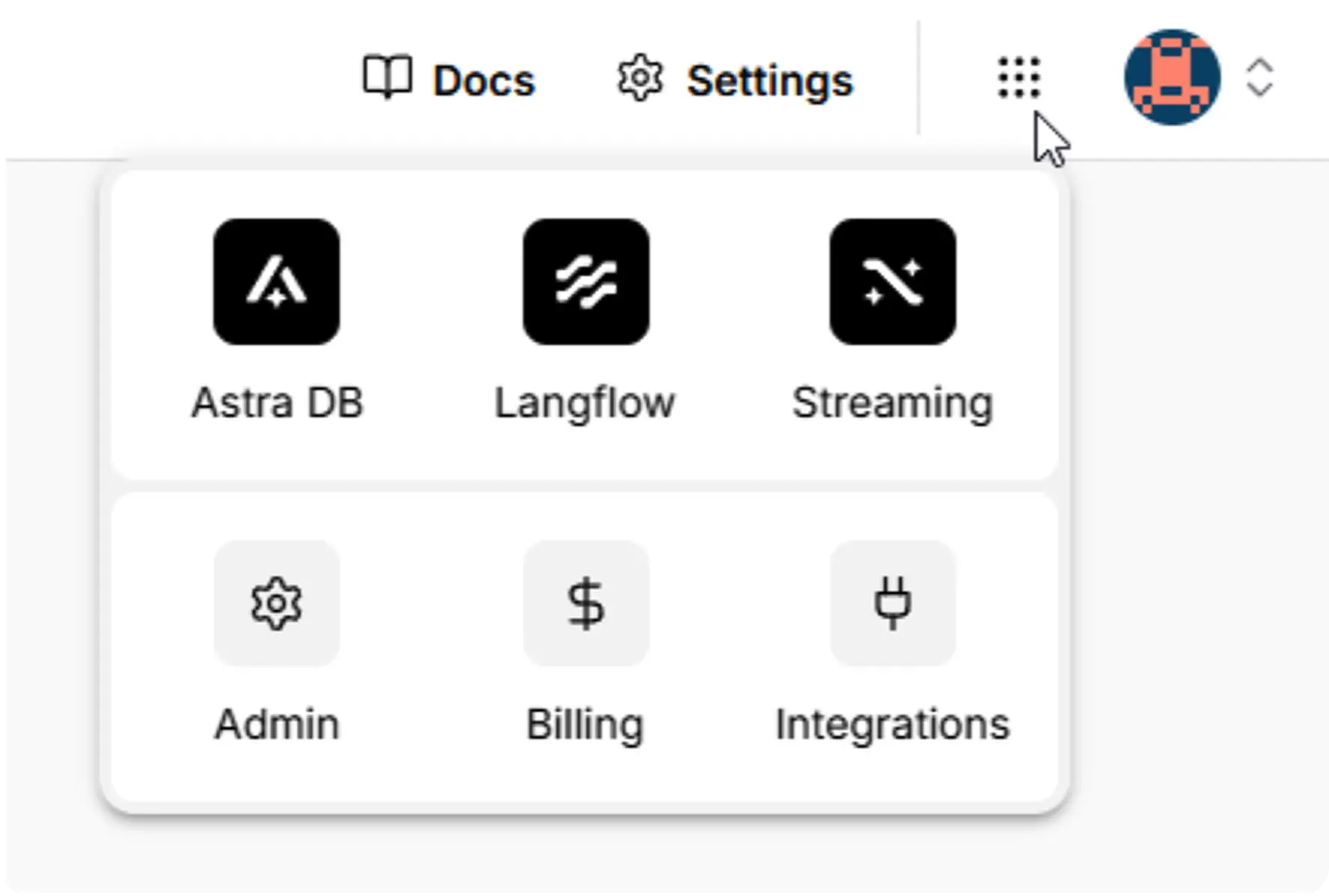
Create a free Astra account using your own credentials or one of the supported Single Sign-On (SSO) providers. Then, click on the Applications icon and click Langflow.
Construct and test a basic agent
Let’s say you wanted to construct a simple agent. From Langflow, select the Simple Agent template to construct the basic building blocks:
[Include animation from https://www.langflow.org/blog/create-your-first-ai-agent, assuming this asset is up to date]
The components include:
-
Agent: Connects the LLM to other components. You can select your preferred LLM and input an API key from the vendor to authorize calls. Inputs and outputs. Accepts input from an external system or interactive user (defaults to a chat window) and returns the results from the LLM, either raw or filtered through other components.
-
Tools: The basic agent by default wires in a URL component to retrieve data from the Web, along with a Calculator component to perform basic arithmetic functions. This default agent is a fully runnable application. You can click the Playground icon in the upper right corner to launch a chat window. From there, you can make requests such as converting currency, summarizing a news article, etc.
Build on your basic agent
From here, you can edit and build upon the basic agent to suit your needs. A few examples include:
- Add a custom code component to implement your own logic or integrate with other systems. For example, you could pass the response from the LLM through a machine learning pipeline to further refine it, evaluate its overall accuracy, or inform future responses.
- Build a multi-agent deep-research system that breaks complex questions down into smaller tasks that it hands to smaller, more specialized agents, whose results it summarizes into a final response.
- Build and host an MCP server to expose your AI agent to other external agents. This enables hosting agents as reusable components that can be leveraged by other AI agents across the company.
Conclusion
There are many different types of AI agents and AI agent architectures, ranging from single agents to interconnected agent networks. No matter your needs, an enterprise-grade AI agent builder can reduce ramp-up, slash development time, and provide out-of-the-box scalability.
The Langflow AI agent builder is the fastest way to build and deploy AI apps. To get started, create an account and walk through the quickstart guide.
Create your first flow
Drag, drop, connect. Go from idea to working AI application in minutes, not weeks.